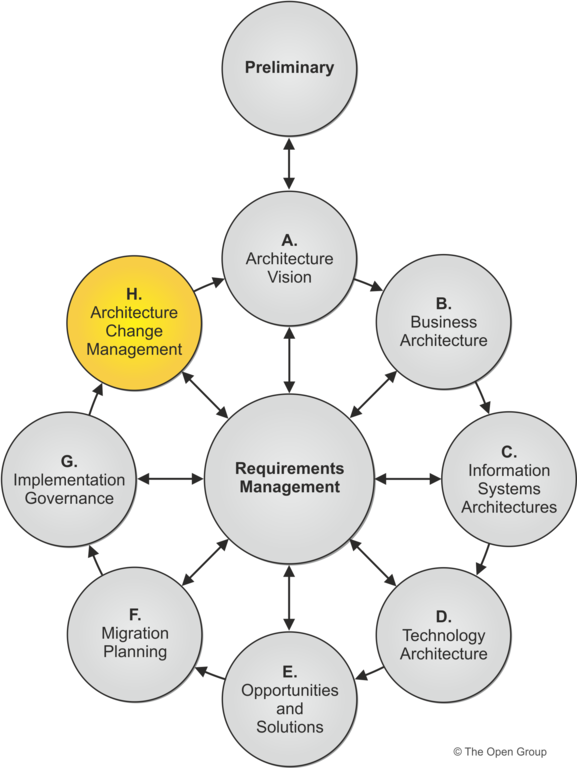
| You are here: | ||
| <<< Previous | Home | Next >>> |
This chapter looks at establishing procedures for managing change to the new architecture.
The objectives of Phase H are to:
This section defines the inputs to Phase H.
The level of detail addressed in Phase H will depend on the scope and goals of the overall architecture effort.
The order of the steps in Phase H as well as the time at which they are formally started and completed should be adapted to the situation at hand in accordance with the established Architecture Governance.
The steps in Phase H are as follows:
Influence business projects to exploit the Enterprise Architecture for value realization (outcomes).
Ensure monitoring tools are deployed and applied to enable the following:
Manage Enterprise Architecture risks and provide recommendations for IT strategy.
Provide analysis for architecture change management:
Make recommendations on change requirements to meet performance targets and development of position to act.
Manage governance process and framework for architecture:
Activate the architecture process to implement change:
The outputs of Phase H may include, but are not restricted to:
The goal of an architecture change management process is to ensure that the architecture achieves its original target business value. This includes managing changes to the architecture in a cohesive and architected way.
This process will typically provide for the continual monitoring of such things as governance requests, new developments in technology, and changes in the business environment. When changes are identified, change management will determine whether to formally initiate a new architecture evolution cycle.
Additionally, the architecture change management process aims to establish and support the implemented Enterprise Architecture as a dynamic architecture; that is, one having the flexibility to evolve rapidly in response to changes in the technology and business environment.
Monitoring business growth and decline is a critical aspect of this phase. Usage of the Enterprise Architecture is the most important part of the architecture development cycle. All too often the business has been left with an Enterprise Architecture that works for the organization of yesterday but may not give back sufficient capability to meet the needs of the enterprise of today and tomorrow.
In many cases the architecture continues to fit, but the solutions underlying them may not, and some changes are required. The Enterprise Architect needs to be aware of these change requirements and considers this an essential part of constant renewal of the architecture.
Capacity measurement and recommendations for planning are a key aspect of this phase. While the architecture has been built to deliver a steady state Business Architecture with agreed capacity during the lifecycle of this Enterprise Architecture, the growth or decline in usage needs to be continually assessed to ensure that maximum business value is achieved.
For example, some Solution Architectures may not lend themselves to be scalable by a large factor - say 10 - or alternative solutions may be more economic when scaled up. While the architecture specifications may not change, the solutions or their operational context may change.
If the performance management and reporting has been built into the work products through previous phases, then this phase is about ensuring the effectiveness of these. If there needs to be additional monitoring or reporting, then this phase will handle the changes.
The value and change management process, once established, will determine:
The architecture change management process is very closely related to the Architecture Governance processes of the enterprise, and to the management of the Architecture Contract (see Part VI, 43. Architecture Contracts) between the architecture function and the business users of the enterprise.
In Phase H it is critical that the governance body establish criteria to judge whether a Change Request warrants just an architecture update or whether it warrants starting a new cycle of the Architecture Development Method (ADM). It is especially important to avoid "creeping elegance", and the governance body must continue to look for changes that relate directly to business value.
An Architecture Compliance report should state whether the change is compliant to the current architecture. If it is non-compliant, an exemption may be granted with valid rationale. If the change has high impact on the architecture, then a strategy to manage its impact should be defined.
Guidelines for establishing these criteria are difficult to prescribe, as many companies accept risk differently, but as the ADM is exercised, the maturity level of the governance body will improve, and criteria will become clear for specific needs.
The main purpose for the development of the Enterprise Architecture so far has been strategic direction and top-down architecture and project generation to achieve corporate capabilities. However, Enterprise Architecture does not operate in a vacuum. There is usually an existing infrastructure and business which is already providing value.
There are also probably drivers for change which are often bottom-up, based upon modifying the existing infrastructure to enhance functionality. Enterprise Architecture changes this paradigm by a strategic top-down approach to a degree, although the delivery of increments makes the equation more complex.
There are three ways to change the existing infrastructure that have to be integrated:
Governance will have to handle the co-ordination of these Requests for Change, plus there needs to be a lessons learned process to allow for problems with the recently delivered increments to be resolved and changes made to the Target Architectures being designed and planned.
A lessons learned process ensures that mistakes are made once and not repeated. They can come from anywhere and anyone and cover any aspect of the Enterprise Architecture at any level (strategic, Enterprise Architecture definition, transition, or project). Often an Enterprise Architecture-related lesson may be an indirect outcome of a lesson learned elsewhere in the organization.
The Architecture Board (see Part VI, 41. Architecture Board) assesses and approves Requests for Change (RFC). An RFC is typically in response to known problems but can also include improvements. A challenge for the Architecture Board when handling an RFC is to determine whether it should be approved or whether a project in a Transition Architecture will resolve the issue.
When assessing project or solution fit into the architecture, there may also be the case when an innovative solution or RFC drives a change in the architecture.
In addition, there are many technology-related drivers for architecture Change Requests. For example:
This type of Change Request is normally manageable primarily through an enterprise's change management and Architecture Governance processes.
In addition, there are business drivers for architecture change, including:
This type of Change Request often results in a complete re-development of the architecture, or at least in an iteration of a part of the architecture development cycle, as explained below.
The Enterprise Architecture change management process needs to determine how changes are to be managed, what techniques are to be applied, and what methodologies used. The process also needs a filtering function that determines which phases of the architecture development process are impacted by requirements. For example, changes that affect only migration may be of no interest in the architecture development phases.
There are many valid approaches to change management, and various management techniques and methodologies that can be used to manage change; for example, project management methods such as PRINCE2, service management methods such as ITIL, management consultancy methods such as Catalyst, and many others. An enterprise that already has a change management process in place in a field other than architecture (for example, in systems development or project management) may well be able to adapt it for use in relation to architecture.
The following describes an approach to change management, aimed particularly at the support of a dynamic Enterprise Architecture, which may be considered for use if no similar process currently exists.
The approach is based on classifying required architectural changes into one of three categories:
Another way of looking at these three choices is to say that a simplification change to an architecture is often driven by a requirement to reduce investment; an incremental change is driven by a requirement to derive additional value from existing investment; and a re-architecting change is driven by a requirement to increase investment in order to create new value for exploitation.
To determine whether a change is simplification, incremental, or re-architecting, the following activities are undertaken:
A good guideline is:
For example:
In particular, a refreshment cycle (partial or complete re-architecting) may be required if:
If there is a need for a refreshment cycle, then a new Request for Architecture Work must be issued (to move to another cycle).
 return to top of page