

Healthcare Forum

About the Forum

The Open Group Healthcare Forum is a global, vendor-neutral consortium advancing enterprise architecture, open standards, and practical guidance to improve healthcare delivery. We bring together healthcare providers, technology companies, government organizations, consultants, academic institutions, and other stakeholders to address the complex clinical, operational, and technological challenges facing modern healthcare. The Open Group Healthcare Forum exists to architect the healthcare enterprise — bridging the gap between strategy and execution, and between business and technology, in an industry where enterprise architecture has historically lagged behind other sectors. Our mission is simple: to help make healthcare information available when and where it’s needed, so that it follows the person, in a timely, accurate, and secure manner, wherever they go for care. We take a holistic, person-centered, systems-oriented approach to this work. We don’t believe healthcare’s challenges are simply technical problems requiring technical solutions — they require understanding the interdependence of the many parts of the healthcare ecosystem: clinical, operational, financial, and regulatory. This approach aligns closely with the goals of Boundaryless Information Flow™, the Triple Aim, the Learning Healthcare System, Value-Based Healthcare, and population health. The Forum is global, vendor-neutral, and business-oriented, bringing together governing bodies, technology vendors, and the provider community — hospitals, healthcare delivery systems, and innovation hubs of every kind — to share best practices and the accumulated wisdom of our membership. Members participate through weekly virtual meetings and quarterly in-person events.

Mission and Vision

The Healthcare Forum is more than a standards body. It is a collaborative community of architects, clinicians, technologists, and business leaders working together to improve healthcare systems through practical, architecture-based solutions.

Healthcare Interoperability

We believe that person-centered, value-based healthcare depends on interoperability. Interoperability enables the flow of information within and across healthcare systems. Information flow based on healthcare system requirements, standards development, and IT implementation systems helps enable actors to produce their core capabilities effectively, error-free, and securely. Learn more


Value Proposition

Healthcare is one of the world's most complex and information-intensive industries. Improving patient care requires more than technology alone; it requires coordinated improvements across clinical practice, business operations, governance, information, and technology. The Healthcare Forum helps organizations bridge strategy and implementation by developing practical architectural guidance that improves interoperability, cybersecurity, operational resilience, and value-based care.


Our Work:

The Healthcare Forum develops enterprise architecture standards, reference architectures, implementation guides, information models, and open-source tools that help healthcare organizations improve clinical care, operational performance, interoperability, cybersecurity, and digital transformation. Working collaboratively across industry, government, academia, and technology providers, Forum members translate emerging ideas into practical guidance that can be applied in healthcare organizations worldwide. Our work bridges strategy and implementation by helping healthcare organizations build the enduring organizational capabilities needed to adapt to changing technologies, evolving threats, and new models of care.


O-VBA (Value-Based Architecture for Healthcare) — a standard giving Enterprise Architects a reusable, extensible tool for continuously improving the value and efficiency of patient-centered care across medical specialties and clinical settings.
FHIM (Federal Health Information Model) and the FHIM Profile Builder (FPB) — an open-source tool that automates the creation of standards-based API profiles, enabling widespread interoperability.
O-HERA (Health Enterprise Reference Architecture) — a downloadable ArchiMate® model and guide for developing implementation reference architectures, usable by healthcare and IT stakeholders of every size.
Ongoing work developing healthcare cybersecurity guidance, in collaboration with The Open Group Security Forum, applying the same architectural rigor to the threats and controls healthcare organizations face today.


Why Join the Healthcare Forum?

Healthcare is too complex for any one organization to solve alone. The Healthcare Forum provides a trusted, vendor-neutral environment where healthcare providers, technology companies, government agencies, consultants, researchers, and academic institutions collaborate to develop practical architectural guidance that addresses real-world healthcare challenges. Members influence the Forum's priorities, contribute directly to standards and guidance, validate emerging ideas through real-world case studies, and help shape the future of enterprise architecture in healthcare. Through this collaboration, organizations gain early insight into emerging practices while building relationships with peers who are committed to improving healthcare delivery worldwide.

Members of the Healthcare Forum have the opportunity to:

  • Influence the future of healthcare enterprise architecture by contributing to standards, guides, reference architectures, and open-source tools.
  • Collaborate with a global network of experts from healthcare providers, technology companies, government agencies, consulting firms, and academia.
  • Apply architecture to real-world challenges, including interoperability, cybersecurity, value-based care, operational resilience, and digital transformation.
  • Share and learn from practical experience through case studies, implementation guidance, and peer collaboration.
  • Help shape industry direction by participating in a vendor-neutral consensus process that transforms ideas into internationally recognized guidance.
  • Build lasting professional relationships with leaders who are advancing healthcare through enterprise architecture.

Healthcare Forum Membership Benefits Healthcare Consultants, Payers, and Providers

  • Guide standards development to ensure adoption of necessary requirements for interoperable solutions
  • Improve information flow within your organization and with partners in your care delivery ecosystem 
  • Address your pressing Healthcare IT business problems
  • Engage in regular dialog with diverse healthcare stakeholdders about improved interoperability and information flow
  • Drive the healthcare community towards less proprietary, more open solutions to reduce lock-in and improve business efficiencies
  • Gain business efficiencies through better information flow with ecosystem partners at a lower cost


Healthcare Forum Membership Benefits IT Hardware, Software, and Consulting Services Vendors and Medical Device Vendors

  • Influence standards development and gain early access to emerging standards that affect your business
  • Gain a clearer and more empathic understanding of customer HIT and EHR pain-points and requirements
  • Demonstrate leadership in Healthcare IT – show customers and collaborators your commitment to improving information flow in care delivery and outcomes improvement
  • Collaborate with other innovators; prepare for the future; develop key relationships

The Open Group Healthcare Forum is advancing the O-VBA to help healthcare organizations design and improve their enterprises around value creation and outcomes.

The O-VBA is a top-down framework (based in TOGAF) and a bottom-up tool (based in ArchiMate) used to link strategic goals to the capabilities (the what) and the competencies (the how) needed to achieve them. By organizing work around value streams—the end-to-end stages through which healthcare organizations deliver value—the O-VBA helps leaders and teams see how people, workflows, information, and technology interact to produce outcomes that matter to people.

Originally developed for hospitals and healthcare delivery systems, the O-VBA is industry-independent. Its structured approach to mapping value streams and capabilities can be applied across sectors to accelerate transformation, reduce complexity, and align investment with measurable results.

Case Studies: Applying the O-VBA in Practice

The Healthcare Forum has developed and tested the O-VBA through real-world case studies that demonstrate its value in addressing complex clinical and operational challenges:

  • Case Study 1: Medication Management Resilience
    A large healthcare system used the O-VBA to strengthen its business continuity planning for medication management during IT outages. By mapping value streams and identifying the capabilities that must function manually or on backup systems, the organization reduced risk and improved clinical response readiness.
     
  • Case Study 2: Strengthening Incident Management Communication
    In a separate engagement, the O-VBA was applied to enhance communication pathways during digital disruptions. It helped clarify roles, responsibilities, and information flows across clinical and IT teams, leading to faster decision-making and improved coordination under pressure.

Who It’s For

The O-VBA is designed for:

  • Enterprise Architects and transformation leaders seeking to connect strategy with execution
  • Healthcare executives and clinical operations teams looking to manage complexity and drive measurable improvement
  • IT and digital health professionals aiming to align technology initiatives with business and patient outcomes

What’s Next

The Forum is expanding its O-VBA work through additional case studies and collaborations across industries and regions. These projects continue to demonstrate how a value-based architectural approach can make transformation more actionable, measurable, and sustainable.

About

The Healthcare Forum, in collaboration with the Dutch center of excellence for health IT, Nictiz, has translated and expanded the Dutch ZiRA.  The ZiRA in English Guide is an open-source hospital reference architecture that can be used to solve business problems and improve patient care in any hospital system worldwide.  It is:

  • Proven
  • Easy to use at no cost
  • Continuously enhanced by members of The Open Group Healthcare Forum


The following Files are available to Use the ZiRA in English                
 

ZiRA v1.2.eap is a Sparx Enterprise Architect* file and the source file of the ZiRA containing all ZiRA elements and views (models)

ZiRA v1.2.archimate is the Archi** file with all the ZiRA elements and main views from the ZiRA source file and can be directly opened in Archi

ZiRA v1.2.xml is the ArchiMate Model Exchange file with all the ZiRA elements from the ZiRA source file and can be used to import in an architecture tool

ZiRA v1.2.xlsx is an Excel spreadsheet that contains different tabs with overviews of principles, services, business functions, processes and information domains, application functions and matrices of information objects with zibs and clustering of business activities and information objects in the information domains

ZiRA v1.2.pptx contains all ZiRA models in powerpoint (to adapt them to your own needs)


* The ZiRA source file (.eap) is modeled with the Enterprise Architect tool from Sparx Systems: www.sparxsystems.com

** The ZiRA Archi file (.archimate) can be (re-)used with the open-source Archi tool: www.archimatetool.com 

fhim logo

The FHIM is the "Federated Health Information Model". It is a complex but elegantly designed framework (including information and terminology modeling) to help enable widespread health information exchange. It is applicable at all levels: local, regional, and global.

The FHIM was developed by the US Government and its contractors, within the now defunct Federal Health Architecture (FHA) Program. The FHIM was supported by over 20 Federal Agencies. It was organizationaly located within the ONC. When the governement selected The Open Group as the new FHIM Steward in 2019, over $5 million and 200,000 person hours had been spent building and using the FHIM, primarily within the VA and DoD.

The FHIM is an integrated model composed of health and healthcare-related content explicitly aligned with industry information models and standards. The FHIM addresses two persistent gaps:

  • The “too many standards” problem in healthcare
  • Data inconsistencies within and between standards

The FHIM supports the exchange of meaningful, interoperable information, quickly and accurately and consistently, for the betterment of patient care.

The FHIM Profile Builder (FPB) is an open source tool managed by The Open Group that responds to the need to produce standards-based API profiles that can be easily reused to promote widespread interoperability. The FPB can automate profile building, rendering the use of APIs, such as FHIR, functional without special effort, as required by legislation (in the US) and the exigencies of typical clinical practice settings.
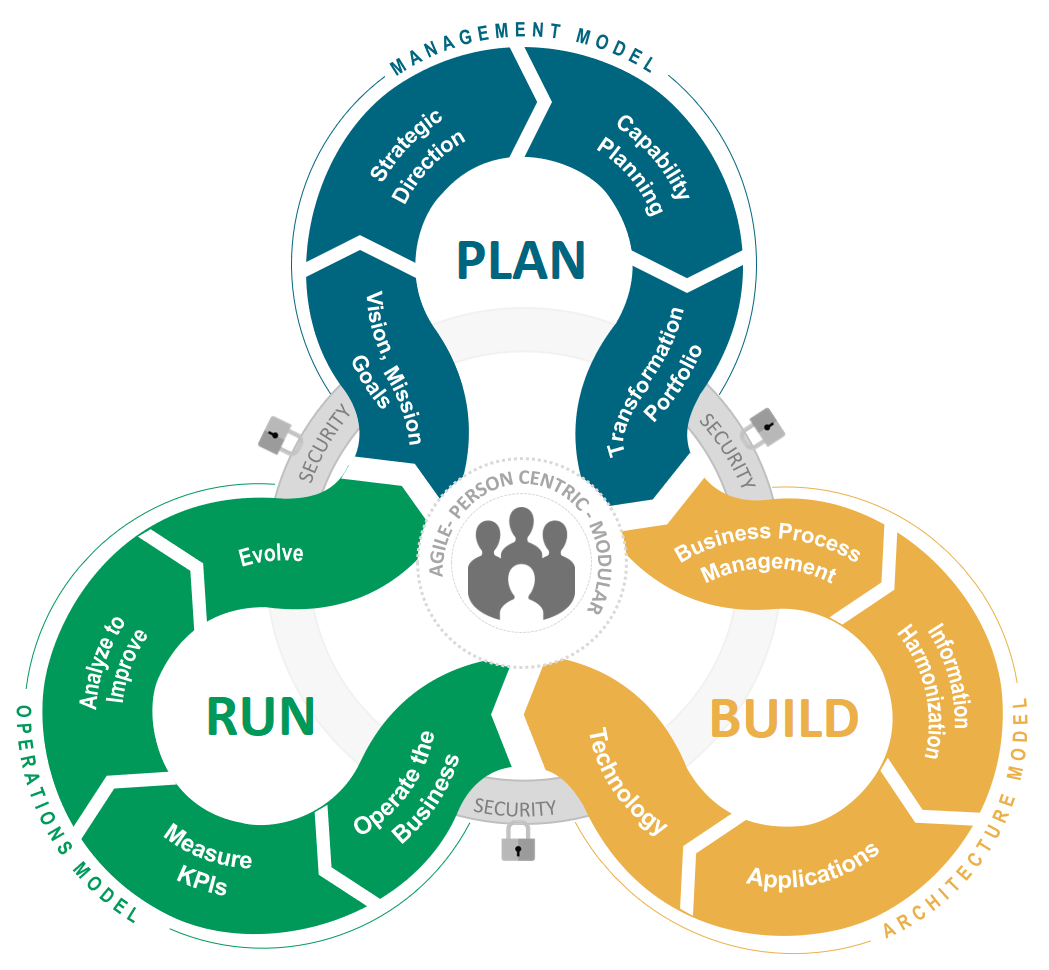
O-hera diagram

Health Enterprise Reference Architecture (O-HERA)

The Healthcare Forum has developed a comprehensive, 12-step framework designed to identify and deliver digital solutions to data issues experienced by health services delivery enterprises and their vendors.

The Framework is rooted in deep knowledge of:

1) Health services provider and supplier industries, including the political, technical, and socio-cultural contexts in which they operate

2) The barriers and benefits to using HIT to solve business problems

3) Best practices and lessons learned from using Enterprise Architecture methods to create efficiencies in industries as diverse as communications, financial services, and defense

Using the Healthcare Architectural Framework, the Healthcare Forum is also developing a Health Enterprise Reference Architecture (HERA):

1) To provide a downloadable ArchiMate® model and guide to develop implementation reference architectures

2) HERA can be implemented by a wide range of healthcare and IT stakeholders, using a wide range of tools available to them, and tailored to legacy systems

Events

The Open Group events are for business and technology professionals interested in achieving business objectives through technology standards. The Open Group organizes conferences, member meetings, industry verticals, webinars, and podcasts on a wide variety of topics.

Check our events calendar for upcoming events.

Follow The Open Group on X (formerly Twitter) @theopengroup

Healthcare Library

Websites:

www.fhim.org

Snaphots:

HEALTH ENTERPRISE REFERENCE ARCHITECTURE (O-HERA) 

The HERA is a framework for the development of a reference architecture for a healthcare company, from big to small (50 employees or more). It is a logical, cognitive map that can help most healthcare stakeholders improve their business by using IT in a smarter way. 

White Papers:  

HEALTHCARE INTEROPERABILITY 

The Open Group Healthcare Forum seeks to advance interoperability to exchange key health and healthcare data.

ENHANCING HEALTH INFORMATION EXCHANGE WITH THE FHIM

The goal of the Federal Health Information Model (FHIM) is to support semantic interoperability and harmonize information requirements from federal partners and standards organizations. One might say it aims to bring Boundaryless Information Flow™ to Healthcare. How well does it do this? How can it be used to enhance interoperability on a broad scale? These are the questions addressed in this non-technical paper written by private and public sector global and enterprise architecture experts.

Data Sheets:

THE OPEN GROUP HEALTHCARE FORUM

Podcasts:  

HOW THE OPEN GROUP HEALTHCARE FORUM AND HEALTH ENTERPRISE REFERENCE ARCHITECTURE IMPROVE PROCESS AND TECHNOLOGY ILLS

Transcript of a discussion on how a global standards body and its ecosystem of partners are working to improve how the healthcare industry operates.